This semester has come to the end. In this semester, I have tried some English courses which have different focus from the courses I learned before. ENG 218 is such a class.
In ENG 218, I have learned a lot about
public writing.
Firstly, the “Current Issue” group
project is important for me. As it took much time, I have explored a lot about
our topic “Environmental/Pollution in Pacific Ocean”. I have learned a lot about
the situation of the endangered sea life and the protection solutions done by
different countries and organizations during the search. Also, I think I have
learned and applied rhetorical analysis in this project. In the process that I was
doing research, I realized that there are differences between “hunting” and “overhunting”.
So, I analyzed how to use the two words in different situations. What’s more, I
have learned how to make a website. Aside from putting enough pictures and
videos to help audience understand our points, I realize that it is also
important to make the webpage be organized well which means making our webpage
clear for audience to browse. Because at the beginning of making the website,
we had not pay attention to this. When we saw the draft, I felt it a little bit
chaotic. So, I paid attention to adjusting the formats and matching the
pictures with words. What’s more, I have learned a lot about cooperation between
groupmates.
Secondly, the final project about “Analysis
of Written Communication Practices in a Community/NonProfit Organization” makes
me improve a lot. I seldom go to the place which I search and this time, I think
I tried a lot of new. I went to the Lowell Observatory and tried to communicate
with their manager. Also, I visited the Lowell Observatory in the respective of
my audience and analyzed both their advantages and disadvantages. I started to
treat everything I research objectively instead of only paying attention to
their advantages. And this was the first time that I tried to do the work as a
leader so it made me more serious and tried my best to consider everything and make
sure that we keep the right pace. And the work sheet with many questions can shape
our style of thinking or at least give us a direction about how to analyze texts
or other forms such as webpages and brochures. These questions are overall and
detailed. What’s more, I started to consider not just audience like before. I also
think about the primary, secondary, tertiary audience. It makes me to explore
more deeper about the author’s purpose. I think that helps me a lot.
Thirdly, it is not a lesson but I think
it helps me a lot. It is the blog. We wrote blogs in this semester. It is my
first time to create my own blog and put my writing on it and I think it is
interesting as it is freer than most of other forms of writing. I can put some
pictures and videos and any media I would like to share with my audience. Also,
it can let people comment below. It is good way for audience to know the views
of the audience and to make the communicate between the author and the audience.
And I like reading others’ blogs. It can let me discover many new ideas and
when our blog has the same topic, it is great to see some views or perspectives
different from mine. In these blogs that I have written, I learned a lot. I started
to use subtitles to make my paper clearer. And I have practiced to be organized.
I practice to write about a specific point in one or two paragraph and use the
first sentence of each paragraph to clarify what I would talk about in this
paragraph. And the conclusion is important. I have learned to make it more
efficient. It is not a part just for summarizing the content above but a part to
clarify what I want to say supported by the content I write above. So, writing
blog is a new try and I achieves a lot.
Writing is a broad definition and it can be different in different genres. I have studied in Sociology and English and during the process that I write papers for the two subjects, I have discovered some similarities and differences between them. So, I will tell my discoveries in this blog. In the English major, there are many kinds of writing such as creative writing and reports. “The discipline of sociology is concerned with understanding human social groups and structures. It can include the study of social theory as well as empirical research and data analysis, and thus draws from and contributes to other disciplines such as politics, economics, and law.” (LearnEnglish)
Purpose The creative writing, as the name of it, should be more creative than other genres. I have read an article that a writer writes about the disciplines for fiction. He gives 10 steps in writing fiction: 1. Motivation 2. Momentum 3. The nifty 350 4. The furious 500 5. Super Tuesday 6. Celebrate 7. A kick in the rear 8. Keep a log 9. Get healthy 10. Retreat and advance (James Scott Bell). The ten steps are all about how to keep a writer writing and how to create good work. They seem to be not about writing itself but I think they can illustrate an important point that creative writing needs the writers’ inspiration and imagination. Fiction should be attractive. To achieve this, great imagination does matter. When it comes to Sociology, the papers for Sociology cannot include imagination. It needs credibility more because it can be a reference for readers. That means the papers are possible to be understood as telling the truth in society so the papers cannot be fake or unsupported. It is a difference. But I think the difference can be a similarity between writing for English and Sociology. As I mentioned above, writing for English has many genres. When we write reports, credibility can be a very important thing. As a report is “an account given of a particular matter, especially in the form of an official document, after thorough investigation or consideration by an appointed person or body.” (Google) That’s why I said credibility is important in reports. Also, in reports and Sociology papers, the citation can be important.
Tone In creative writing, the writers’ tone can be exaggerated or humorous. Also, it can be horrible to make their stories to achieve the effects they want. In a word, the tone of creative-writing writers can be flexible. When it comes to papers in Sociology, I have referred to a book called “Writing for Sociology”. In this book, it tells many points and I picked up two of them: 1). Develop your writer’s voice. No matter what you write, your voice should be present throughout, so that the reader feels engaged with what you are arguing, pondering or illustrating. 2). Be clear. In a verbal conversation, you can find out quickly if someone misunderstood you. As a student, if you haven’t been clear enough with your writing, you often will not find out until you get your grade. You must say exactly what you mean the first time So, in Sociology, the tone should be serious and clear so that writers can let their audience believe in what they write in their papers.
Wording The wording in creative writing can be magnificent. And the things that describe can be that does not exist in the real world. But in Sociology, the wording will be stricter. My teacher in Sociology lesson has told us that it can be serious if we define a person as a racist. So, words like “racist” should be thought over and over before we use.
Content In this part, I want to introduce the papers I write most when I study in Sociology. Every week, we need to submit a DAR. The teacher will give us reading the material and let us read it. What we should do is to summarize and pick out some points in the material and then choose some words that we are not familiar with to explain. We also need to look for the link which is connected to our textbook. This homework can show that there are many specialized words in an area. As the webpage I have read says: “To write assignments about sociology, the first thing you need to know is the vocabulary.” It is similar to all the other subjects. Each subject has its own terminology and when we try to write for the subject, we should know the terminology. All the above are the similarities and differences that I want to share. If you have more ideas, welcome to talk to me.
Our group topic is “Environmental/Pollution in the Pacific
Ocean” so I am searching about it during these days. Our group chooses to
explore different reasons why there are more and more endangered sea life.
These reasons must be from the environment which means the changes in nature
like climate changes. Another meaning of “the environment” is
including influences caused by human’s actions to sea life. In these aspects, I
focus on one type of human’s actions —hunting.
The recent years, we have heard or watched many reports about the
situation that there are more and more animals to be endangered even close to
extinction. We also heard there are some trades in precious animals which are
not allowed by the laws. Driven by huge interests, the hunting is hard to be
controlled and eliminated.
Actually, at the beginning of the project, I met a problem. That is
during the process that I search, I find that there is another word which is
“overhunting”. The appearance of the word gave me a feeling that it
seems that “hunting” is allowable. It will not cause any damage.
While “overhunting” is the action that should be forbidden. I had
thought about the question for a few days. However, as I have made my research
deeper and watched more videos, I was aware of the important point that I focus
and I knew about which word I would use.
We can hunt indeed. But what we should pay attention to is what we hunt. Sometimes, hunting can be a way to maintain the balance in nature just like wolves will catch and eat the weakest deer who run the most slowly. And for sea life in our topic, the same situation also exists. “Options for managing the sustainable use of green turtles: Perceptions of Hammond Islanders in Torres Strait.” said: “Strait Islanders to hunt green turtles is protected, the… hunt, just like I said, take what they need not over… indigenous Australians′ right to hunt” Also, in the ocean, big fish or big animals will eat smaller fish for food. And people living near the sea need to hunt fish or other common life like sea urchin so that they can have food to eat and have products to sell to support their life. The animals are hunted are all those need to be eliminated by nature. It will not cause any great damage to the balance of the environment. But overhunting means hunting a large amount of sea life regardless of the balance of the environment. That not only can cause the life hunted to be endangered but also can cause other sea lives are in danger because they lack food. As the overhunting can break the food chain, it can influence more than one kind of organism. So, lack of food can be a reason why those sea lives would be endangered and also, it can be an aspect of the indirect influence of human’s hunting actions.
When it comes to bigger and less common sea life like seals,
dolphins, whales and so on, hunting is forbidden, let alone overhunting.
Unfortunately, hunting those precious sea lives still happens. “From
snails to whales, approximately 2,270 species are listed as endangered or
threatened globally under the U.S. Endangered Species Act (ESA). Of the species
that are listed, approximately 150 of them live in the ocean in U.S. waters,
and some are considered closer to extinction than others. Many species of sea
turtles, sharks, whales, manatees, and sawfish are endangered and in most
cases, it’s not predators that are causing their decline, it’s humans. These
ocean species all play an important role in keeping the ocean ecosystem healthy
and they need our help.” The website Smithsonian Ocean wrote the paragraph
above. Many species are endangered now. And their endangering is not because
the law of jungle (or maybe here should be the law of the sea) in nature but
caused by human’s greed.
As we know, sea life has great value not just to nature also to
human. For example, sea lions’ fur can be a great material to be scarfs or
clothes to keep people warm. Of course, these can be something distinctive so
that represent wealth or fashion. So, a lot of people will chase after these
products. To earn more money, the hunter will try to hunt more sea life.
There are ten endangered sea lives that are listed by Shamseer
Mambra.
Hawksbill Turtle (Eretmochelys imbricate) …
Vaquita (Phoeocna sinus) …
Blue Whale (Balaenopteramusculus) …
Kemp’s Ridley sea turtle (Lepidochelys kempii) …
Steller Sea Lion (Eumetopiasjubatus) …
Hammerhead Shark (Sphyrna mokarran)
Fin whale (Balaenopteraphysalus)
Hector’s Dolphin (Cephalorhynchushectori)
Hawaiian Monk Seal (Monachusschauinslandi)
Green sea turtle (Cheloniamydas)
Before I started searching for the topic, I just knew that the
amount of some animals is reducing. When many kinds of animals are listed, I
realize how serious and how real the situation is. What have listed are just a
presentation of endangered animals. So, what is the specific reason for the
situation?
Here is a video about one of endangered sea life—seals. It is true
and maybe will make the audience feel terrible.
We can know from the video that how seals were hunted. The hunters
shot them, use pick-mattocks to hit them, throw their bodies into the ocean. It
is distressing to watch those things. And it is obvious that what we have seen
is just a little part of the hunting. The seriousness of the hunting is hard to
imagine. Of course, there are a few other reasons except hunting. My groupmates
will introduce some of them. But I think human’s hunting is the most direct way
to hurt sea life. Also, regulate the climate is a long-time process while
stopping the hunters just need one second. In another word, to prevent hunting
is the relatively easiest way to save sea life and help keep the balance of
nature, I think.
So, how to prevent hunting sea life?
The first way is the actions of the government or related
departments. There is an organization — U.S. Fish & Wildlife Service. In
their official website, I found The Marine Mammal Protection Act (MMPA) was
enacted on October 21, 1972. All marine mammals are protected under the MMPA.
The MMPA prohibits, with certain exceptions, the “take” of marine
mammals in U.S. waters and by U.S. citizens on the high seas, and the
importation of marine mammals and marine mammal products into the U.S. Although
the government in different countries have enact laws to forbidden the
merciless hunting and importation of marine mammals many years ago, the market
that has huge demands for products made of sea life urges the hunters to take
the risk to hunt for considerable money.
And there are some public organizations to appeal to people for
joining in the protection of sea life or at least reduce the possibility that
they choose to buy sea life products. To distinguish with the organizations in
the next paragraph, the organizations I introduced in this paragraph is to help
people and change people’s ideas. The two kinds of organizations have similar
functions but they have their own focus. The first one is Oceana which is
“the largest organization in the world solely devoted to marine
conservation. It was established in 2001 by The Pew Charitable Trusts, the Oak
Foundation, Marisla Foundation, and Rockefeller Brothers Fund. Since its
founding, Oceana has achieved hundreds of concrete policy victories for marine
life and habitats”. (dipndive) Another one is the Ocean Conservancy which
is also “a leading advocacy group working for the protection of special
marine habitats, the restoration of sustainable fisheries and for reducing the
human impact on ocean ecosystems. Founded in 1972, the organization was
initially known as the Delta Conservancy and later the Center for Environmental
Education and the Center for Marine Conservation before receiving its current
name. In order to save our oceans, the group focuses on educating the public
and advocating for policy changes for maintaining vibrant ocean wildlife.”
(dipndive) They are human who hunt the endangered animals. So, to prevent there
are more hunters appear, the education and advocation are very important.
Also, there are organizations to help endangered sea life. First one
is The International Rhino Fund (IRF). “The International Rhino Fund has
been funding and operating rhino conservation programs for the last 25 years to
ensure the survival of rhinos.” (Marike Lauwrens) They also protect Javan
rhinos, greater one-horned rhino, black rhino, white rhino. The second one is
the Project Aware Foundation. “The Project AWARE Foundation is focused on
scuba dive-based marine conservation in our world’s oceans. They have been
supporting and operating ocean conservation projects for over two
decades.” (Marike Lauwrens). Aside from preventing more hunting, we also
need to try to save the animals directly.
There are a lot of
organizations and laws. I think we need to follow them and boycott animal
products. We also need to make different generations know about the seriousness
so that we can reduce the hunting to sea life.
Author credibility
refers to the credentials and other qualities that indicate whether or not a
source is reliable. An author’s credibility helps support the ideas and
arguments in an essay or research paper. (—study.com)
Credibility is fundamental. In the previous blogs, I mentioned that the author’s purpose is to change the readers’ view. So an article with credibility can help to persuade the audience.
So, how to build credibility as a writer?
First is to know who is your audience. Different types of audience need the writer to use different ways or use different types of sources to build his/her credibility. It is similar to what Miller said in “How Do I Make Myself Believable?” in the real world reader. He said “We all have biases. The challenge is to figure out what those biases are and to think about the way they influence both what we are told and what we want to say.”
The second is to build the author’s own
credibility. It can be built by showing the author’s degree or the results of
some researches the author has done. Also, the author can write about his/her
true experience which means use facts to show his/her view. Or the author can
prove how credible the sources he/she uses so that it can prove that what the
author writes is credible. This is an important point that when I looked over
some websites about building credibility, citing sources appears many times.
Thirdly, “Show, don’t tell.” (printwand) In my opinion, this point is important. It decides whether the audience have the patience or whether they are willing to read the whole article. And even you have credibility, the audience can choose to not trust you if you just tell the fact you think and do not give some specific evidence. The audience need to be persuaded instead of being taught and told.
What’s more, I think, authors can regard
themselves as readers so that they can discover where their articles are weak.
Or authors can show their articles to their friends or families and ask for
their advice as readers.
Credibility —Audience/Readers
How about the time we are the audience? At that time, we need to pay attention to distinguishing correct and false information. A few days ago, I was thinking about how can I distinguish the pictures that are fake. As we know, with the development of technique, we cannot totally believe what we see. The pictures online can be beautified by photoshop and the articles online can have many hidden meanings so that the author can earn more benefits. I have seen a website that discloses some attractions that different from their description. For example, “The setting of Shakespeare’s tragic love story is one of Italy’s most beloved attractions, but unfortunately, Juliet’s isn’t real. Aside from the fact that balconies didn’t even exist in Shakespearean England, Romeo and Juliet were fictional characters, so the balcony you see just belongs to one business-savvy Italian!” (Alex O’Brien, Oversixty) So, how to distinguish information deserves people’s attention.
The most reliable way is to choose websites that have a reputation and there are many people choosing to use them. So, when it comes to choosing authors, judging an author’s credibility can be from his/her degree and the comments to his/her previous articles.
Another advice is to try to find the author’s tone in writing. It is a way to judge if the author is reliable or how to understand his/her meaning. As for me, if the author is confident and modest, I would trust him/her more. But, when I find the author is overconfident, I will be careful about the level of severity he/she describes.
Also, we can pay
attention to the sources that the author uses. “where they come from, the
credential of those being cited and so on” (Miller) If the sources he/she uses
are credible and reasonable, the author’s credibility can be more reliable.
Last but not least, don’t totally trust it even the author is usually credible. When reading articles, using your critiques to judge whether the author’s opinion and the explanation are reasonable and where is the vulnerability. If the drawbacks are serious and cannot be described, the credibility of the author should be doubted.
So, credibility for authors should be a
principle in writing and a tool to help strengthen the articles. When it comes
to audience, credibility is a criterion to judge whether the article is
reliable. The communication between authors and readers should base on
credibility so that human’s mental world can be better and richer.
Above are my thinking about credibility
after reading some materials. If you have some opinions or advice, welcome to
talk to me!
I want to use a question to start this blog: What is “argument”?
It is the
opinion of the author. Most of them are different from another opinion so
authors will come up with arguments to change the opinions of the audience. It
is necessary to know that “while argument does involve putting up our views
against those of other people, this doesn’t mean that argument is solely about
conflict. In its fullest form, in fact, argument works as a powerful vehicle
for exchanging views rather than stifling them: a way to spur to dialogue and
create common ground.” (Miller, Chapter 7, the real world reader)
When we read an article, to understand and analyze the author’s argument is important. Because the content should be around and to prove the argument or to arouse the audience’s thinking. First, we should understand the topic that the writer raises and find the argument on this topic. I remembered that in the first semester I studied in the college here, I thought that Chinese food is not popular in America because I didn’t see many Chinese restaurants or many kinds of Chinese food in our dining hall. But one of my teachers told me that Chinese food is popular in America. Then, I used “the popularity of Chinese food in America” as the topic of my project. In this topic, the argument can be “Chinese food is popular in America.” or “Chinese food is not popular in America”. I set my audience as the people who think Chinese food is not popular in America or who do not know whether Chinese food is popular in America. So, my purpose is to exchange my audience’s views by making an argument.
When
the author makes an argument, it is greatly possible that the audience will
make critiques or counterpoints. So, using sources with credit and using
appropriate language are important.
To
express the argument clearly, “voice” can be crucial.
So,what is “voice” in writing?
It is the
writing style of an author. Just as the video followed tells us:” Think of it
as her style.” It can be different when appears in articles written for
different occasions or in different authors’ articles.
It is
interesting that in this video, the maker clarifies the difference between
“voice” and “tone”. “’Voice’ is the way an author gets their message across.
‘Tone’ is the emotion in the writing.” When I read “the real world reader” of
Miller, I think tone can be another way to call voice. But this video gives a
new explanation.
The word choice
can show the author’s voice. I used to use “I think……” in my articles. But when
I read the textbook, I found that “I” can be a representation of a tone of
self-confidence. Then I rethought my writing. I found that I focused on my own
analysis. A confident voice can let the audience believe in the author and help
the author’s opinion to be accepted.
As we know, voice has “active voice” and “passive voice”. Someone says, active voice is better than passive voice as passive voice can make some misunderstanding, because “they do not specify the actors, the passive constructions contribute to the ambiguity of this sentence.” (Jerz’s Literacy Weblog) But I found that a man called Issa Atoum said: “In scientific writing, many people tend to use passive voice. On the other hand, many readers believe that active voice is clearer than passive voice.” Obviously, somebody support passive voice and someone prefer active voice. The reason for this situation is that the backgrounds that they set the question in are different. One is in common life and another is in scientific writing.
So, to write a good article and have a good argument and voice, we should pay attention to what occasion we would post our articles. When we pay attention to the content we would post, we can ensure what voice we should use. No matter what voice we choose, it should be honest and the content should be arguable but we need to have enough content to support our views. And a humorous or ironic tone can make the process of argument or discussion less boring.
And when we are readers, we should pay attention to the purpose of the author writing the article and read their books with critical thinking. Because since the author come up with an argument, there could be different views even controversial views. We should read it with an opened mind and try to understand the author. Meanwhile, we cannot totally believe what the author says. There can have different views.
The content above is my understanding of argument and voice. If you have some opinions, welcome to share with me.
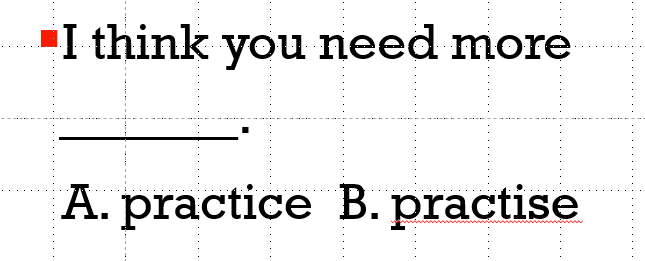
There is a question that makes me confused since high school. The question is “what is the difference between ‘practice’ and ‘practise’?” In my high school, there was a multiple-choice question:
“I
think you need more _________.
practice B. practise “
I don’t know why
it is so hard for me to remember the difference. Maybe I could remember the
difference for a few days but I would forget it later.
To work out the
question, first, I looked up to a Chinese dictionary called Youdao. In this
dictionary, I found that “practise” is a noun and “practice” is a verb and a
noun. The two words that are spelled similarly have the same meaning. Then I
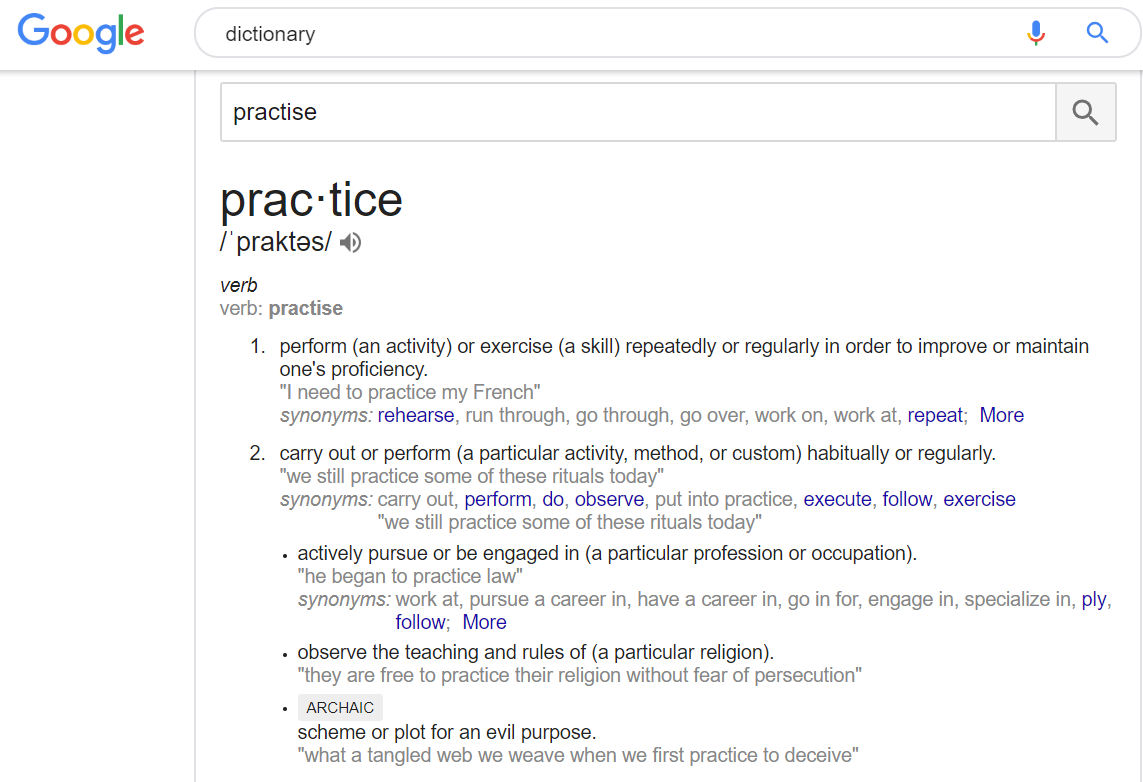
looked up to the Google dictionary, the result was surprised. When I typed
“practise”, there was only explanations of “practice” and “practice” is just a
verb.
In the two different dictionaries, I found two different explanations. So, I started to search on other websites and tried to find people’s explanations. The first website I entered was “Quora”. A man called Joel Mogera said:” Do not confuse “practice” with “practise”. They sound the same and even look similar (except that one is spelled with a “c” and the other with a “s”) but their meanings are different. The word “practice” is a noun, it refers to an act itself, not who is doing it. On the other hand, practise is a verb meaning ‘do something repeatedly to improve one skill’. It is a systematic training by multiple repetitions (rehearsing a behavior or engaging in an activity several times repeatedly) in order to improve or mastering that skill. To put this much simply, practise is a verb (doing word) and practice a noun (thing).” (Joel Mogera, 2018, Quora) It seems that Joel Mogera insists that “practice” is just a noun but he gives an explanation about the situation that “practice” can be used as a noun and a verb. Later he mentioned that:” It should be noted that in American English, both the noun and the verb are spelled ‘practice’. Both forms are however used in the British English whereas the distinction is almost obsolete in the U.S. As a matter of fact, in other English-speaking countries (Australia, Canada, UK, Ireland, and South Africa), ‘practice’ is the noun and ‘practise’ the verb. It is therefore important to make sure that use the right version for the right audience. Here are some examples below using the word ‘practice’ (a noun) and ‘practise’ (a verb)” This explanation, I think, can explain clearly and all-roundly because he not only clarifies the difference between the two words but also explains why there are different definitions existing. There are distinctions between different countries’ English.
To
make sure what the differences between the two words are, I looked over another
website called “Grammarist”. The explanation is “In the main varieties of
English from outside North America, practice is the noun, and practise is the
verb. For instance, we would say that a doctor with a private practice
practises privately. There is no such distinction in American English, where
practice is both a noun and a verb, and practise is not used at all. Canadian
English also favors practise as the verb, but practice appears with relative
frequency as a verb (about a third as often as practise).” This website tells
me more information. Also, it is because every country has different principles
and usage even in the same question. Some countries just use “practise” while
some countries only use “practice”. What’s more, some countries will use the
two but with different activities like noun and verb.
Actually, there are many questions that have different explanations. And some of them are regarded as common principles which means some words or usage that people are confused about are used commonly but differently by different people. In my opinion, languages are changing constantly and different people have different habits. Also, there are differences between different languages such as American English and British English. However, both of them are English so we can regard such a situation that the same words are used differently as the development of language. More and more people get used to using the form which is different from the original form then it becomes common even becomes a principle. It is important to emphasize that the principle formed in different places can be different. And I have read an interesting sentence, is: “It is a new verb that speakers use systematically like any other verb.” Although he just says about new “verb” I think it can be used in new grammar, new usage and so on. Maybe it is the process that new words, new grammar, and new usage appear.
Sometimes,
there is no need to judge what is the standard or what is correct because in
different places, the “standard” itself is different.
When it comes to the original question about “practise” and “practice”, there is something can be clarified. As the “practise” and “practice” have the same pronunciation, when people use them in oral English, they needn’t pay attention to choosing which one should be used. So, the differences between the two words have been vague gradually. Maybe the pronunciation is the reason why different countries use them differently in written English. But in written English, we should know that “practise” is just a verb and “practice” can be a verb also can be a noun.
If you have some ideas about the two similar words or some questions like this, welcome to talk with me. I am really looking forward to knowing about different explanations to a question. That can make the study more interesting and can bring more knowledge.
When I started to learn writing, the two elements that were emphasized most are audience and purpose. They mean the start of an article. In another word, to write an article, the author should know who are his/her audience and what is his/her purpose or what does he/she want to achieve.
Firstly, it is important to figure out what is “audience” and, what is “purpose”. “Audience” means “the assembled spectators or listeners at a public event” (Wikipedia). Our writing, such as what I am doing now— writing a blog, is a public event as my blog can be seen by anyone in public. And my audience can be different depending on the different topics in my different blogs. Also, people can know who are the audience that the author expected judging from his/her tones. For example, an author indicated that the audience have already acquainted with the basic details of her life,” I thought I’d catch everybody up on what’s new.” (Miller, P147)
Then, except “audience”, another important element is “purpose”. “Purpose” means “the reason for which something is done or created or for which something exists.” (Wikipedia) The purpose is about what an author wants to achieve and what an author wants to change his/her audience. “Purpose” is the reason why an author writes an article. It is important to remember the purpose when we are writing so that the content we write can let the audience understand. Remembering the author’s purpose also can help us as readers to understand the content we read more clearly.
In
brief, the purpose of writing is to influence the audience. So, how to
influence the audience?
Chelsea Henne, who is a digital
marketing specialist, gives the next ten principles.
NO. 1: KNOW YOUR AUDIENCE. That is what I mentioned that different topics are for the different audience.
NO. 2: GET THEIR ATTENTION! To achieve the purpose, an author needs the audience to come to read first so to attract them, pictures or some direct or mysterious titles can work.
NO. 3: PRACTICE MAKES PERFECT. I think it can be understood as improving an article many times before publishing it or trying to write more articles to practice. Also, another way to understand it can be corresponded to The Real World Reader of Miller. It is useful to not just think about the audience before an article being published but to explore the respond of the audience so that the former article can be improved and the next article can be better.
NO. 4: CREATE THINGS YOUR READER WILL REMEMBER. It also can be achieved by posting some pictures that can reflect the content. And also, authors can try to use different ways to clarify his/her opinions such as telling a story or giving a true event. It seems to me that if some knowledge comes with comics or videos, I can understand faster.
NO. 5: DON’T DEMAND. It is relevant to authors’ tones. Different authors have different tones but authors should respect the audience and do not regard the audience as his/her students or underling. Also, everyone has different opinions so authors should allow the appearance of different opinions from the audience.
NO. 6: SPARK QUESTIONS. This point reminds
me that maybe when we start to write an article on a question, we should not
know the results before we finish the article. The content of an article can be
a process to explore and solve the problem but not just repeat the thing that
everybody knows. Even if the question can not be solved in the end, the
question can be a spark question to the audience. It also is a good way to
interact with the audience.
NO. 7: ENTERTAIN. It can be understood as: BE VIVID”. But I think it also can be understood as authors need to accept different opinions. A problem with a lot of different answers is a good question.
NO. 8: BE PROFESSIONAL. As articles are published in the public, validity is greatly important. The content being published should be checked by the author and also, the author should give some opinions that is correct but few people know about.
NO. 9: BE VIVID. That is a way to keep the audience to continue reading. Boring and long content cannot be bore by the audience.
NO. 10: LET YOUR PERSONALITY SHOW. As
Miller said:” The intimate, confiding tone designed to
establish a bond of trust between writer and audience.”
Show the personality can make the audience feel the author’s sincerity.
That’s
my understanding and analysis to the question about writing purpose—to influence the audience and hope it makes sense. Also, welcome to
give advice!
Hello! My name is
Peiyu Zhu. Joyce is another name which is easier. Today, I want to write a
brief introduction about myself.
I am 20 years old.
I come from Suzhou, Jiangsu, China. Suzhou is a beautiful city and has
delicious food and nice people. I grow up in the city and love my hometown very
much. I often miss Suzhou and look forward to going back.
My primary school and high schools are all in Suzhou. Then I went to college in Yangzhou which is near Suzhou. So, coming to America means a big challenge to me. I have to leave my parents and friends for a long time also I need to try to solve the problems that I have met when I start to get in touch with a new culture. The most direct one is language. When I came here, I could not catch up the teachers although they were patient and slowed down their speed to help me understand. I felt a little bit embarrassed in class but I forced myself to face the challenges. I am still trying and learning.
I have a warm family. My father treats me as a friend most of the time. He seldom forces to do the things he thinks that is right. He just gives me advice. My mother is more possible to lose temper so I often argued with her when I was young. But I still love her because I know she loves me too. I am really grateful for their company and I will try my best to company and take care of them just like they have done to me.
When I have spare
time, I like listening to music, watching TV series and taking photos. During
holidays, I love travelling. Travelling alone or with friends and parents both
can make me happy and I think I can grow during my trips. Not only I can watch
more different scenes, but also, I can learn to get along with others and solve
more different problems that I have never met. What’s more, I think travelling
can change the way of thinking. During travelling, I can know what is most
important to me and what can be given up. I like cooking too. Cooking is full
of happiness and I like the process to make delicious food. Also, I like trying
delicious food. So cooking means I can do the thing that I like and then I can
eat the food I like. However, I hate washing dishes.
I am a girl who
doesn’t like assignments. I think when a person is forced to do something he
doesn’t like, it means punishment. What is sadder is that the things I like
turns to be assignments and I have to add something I don’t like or I have to
meet the deadline. It is the thing I opposed to in my mind.
In the last
semester, a teacher asked me about three words that I like most. My answer is
happy, healthy and together.
We work hard now for the future happiness. But the future is always there. The days we are experiencing now are the future of the past. So, we should be happy in the days we are experiencing. I think that it is an attitude towards life. When I meet setbacks and try my best but cannot change it, I will tell myself “let it go”, happiness is most important. We cannot achieve everything we want.
The second one is healthy as it is the most basic in our life. We are healthy so we can try different things that we want. We are healthy so we can keep in a good condition. We are healthy so we can take care of ourselves and the people we love.
I don’t like to say goodbye so I wish the people I love can be together with me forever. Although we have to spread for some reasons because everyone has a different life, we will meet difficulties and share happiness together. The time we are together is the time we value most.
The content above
is something about me that I want to tell. My attitudes towards life, family,
friends and so on.






 Peiyu's mini blog