There is a question that makes me confused since high school. The question is “what is the difference between ‘practice’ and ‘practise’?” In my high school, there was a multiple-choice question:
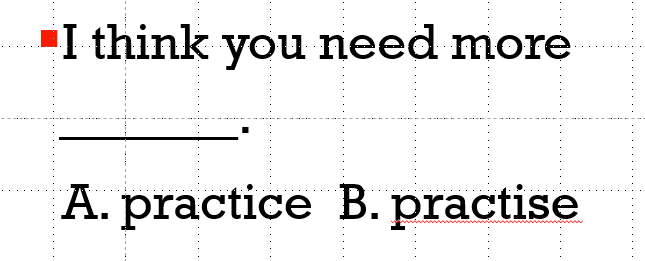
“I think you need more _________.
- practice B. practise “
I don’t know why it is so hard for me to remember the difference. Maybe I could remember the difference for a few days but I would forget it later.
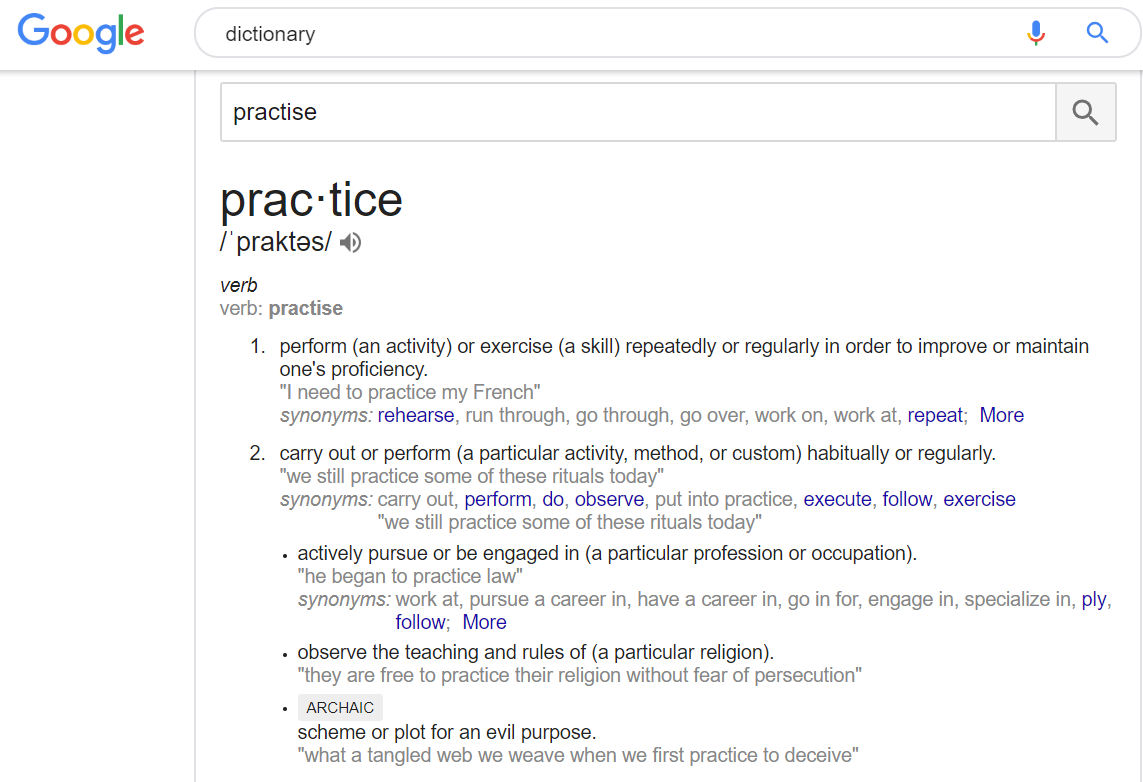
To work out the question, first, I looked up to a Chinese dictionary called Youdao. In this dictionary, I found that “practise” is a noun and “practice” is a verb and a noun. The two words that are spelled similarly have the same meaning. Then I looked up to the Google dictionary, the result was surprised. When I typed “practise”, there was only explanations of “practice” and “practice” is just a verb.


In the two different dictionaries, I found two different explanations. So, I started to search on other websites and tried to find people’s explanations. The first website I entered was “Quora”. A man called Joel Mogera said:” Do not confuse “practice” with “practise”. They sound the same and even look similar (except that one is spelled with a “c” and the other with a “s”) but their meanings are different. The word “practice” is a noun, it refers to an act itself, not who is doing it. On the other hand, practise is a verb meaning ‘do something repeatedly to improve one skill’. It is a systematic training by multiple repetitions (rehearsing a behavior or engaging in an activity several times repeatedly) in order to improve or mastering that skill. To put this much simply, practise is a verb (doing word) and practice a noun (thing).” (Joel Mogera, 2018, Quora) It seems that Joel Mogera insists that “practice” is just a noun but he gives an explanation about the situation that “practice” can be used as a noun and a verb. Later he mentioned that:” It should be noted that in American English, both the noun and the verb are spelled ‘practice’. Both forms are however used in the British English whereas the distinction is almost obsolete in the U.S. As a matter of fact, in other English-speaking countries (Australia, Canada, UK, Ireland, and South Africa), ‘practice’ is the noun and ‘practise’ the verb. It is therefore important to make sure that use the right version for the right audience. Here are some examples below using the word ‘practice’ (a noun) and ‘practise’ (a verb)” This explanation, I think, can explain clearly and all-roundly because he not only clarifies the difference between the two words but also explains why there are different definitions existing. There are distinctions between different countries’ English.

To make sure what the differences between the two words are, I looked over another website called “Grammarist”. The explanation is “In the main varieties of English from outside North America, practice is the noun, and practise is the verb. For instance, we would say that a doctor with a private practice practises privately. There is no such distinction in American English, where practice is both a noun and a verb, and practise is not used at all. Canadian English also favors practise as the verb, but practice appears with relative frequency as a verb (about a third as often as practise).” This website tells me more information. Also, it is because every country has different principles and usage even in the same question. Some countries just use “practise” while some countries only use “practice”. What’s more, some countries will use the two but with different activities like noun and verb.
Actually, there are many questions that have different explanations. And some of them are regarded as common principles which means some words or usage that people are confused about are used commonly but differently by different people. In my opinion, languages are changing constantly and different people have different habits. Also, there are differences between different languages such as American English and British English. However, both of them are English so we can regard such a situation that the same words are used differently as the development of language. More and more people get used to using the form which is different from the original form then it becomes common even becomes a principle. It is important to emphasize that the principle formed in different places can be different. And I have read an interesting sentence, is: “It is a new verb that speakers use systematically like any other verb.” Although he just says about new “verb” I think it can be used in new grammar, new usage and so on. Maybe it is the process that new words, new grammar, and new usage appear.
Sometimes, there is no need to judge what is the standard or what is correct because in different places, the “standard” itself is different.

When it comes to the original question about “practise” and “practice”, there is something can be clarified. As the “practise” and “practice” have the same pronunciation, when people use them in oral English, they needn’t pay attention to choosing which one should be used. So, the differences between the two words have been vague gradually. Maybe the pronunciation is the reason why different countries use them differently in written English. But in written English, we should know that “practise” is just a verb and “practice” can be a verb also can be a noun.
If you have some ideas about the two similar words or some questions like this, welcome to talk with me. I am really looking forward to knowing about different explanations to a question. That can make the study more interesting and can bring more knowledge.

 Peiyu's mini blog
Hi, Peiyu. I think your topic is so interesting. I am so appreciate that you deeply know about and compare the difference between “practise” and “practice”. When I was in high school, it is also so tricky for me. The whole essay is clear and coherent. Thank you for sharing with us.
赞赞